
Freeport-McMoRan - Dominating the Decade
The AI super-cycle demands pure-play, domestic infrastructure. Why $FCX is the company to buy for the deficit of the 2020s.
Before you read this article, I highly recommend my previous analysis, ‘The Copper Chokehold’, which discussed the physical limitations of conductive metals amid the AI infrastructure super-cycle.
This article will not discuss why I expect copper to be so important over the next decade, instead I will outline exactly how I plan to benefit from this multi-year bull cycle, and the reasoning behind all my decisions.
Copper prices have been surging, touching $6.00/pound and are currently very close to making a new all-time high. Capital is flooding into the natural resources sector as institutions scramble to secure exposure to the single most critical bottleneck of the next decade.
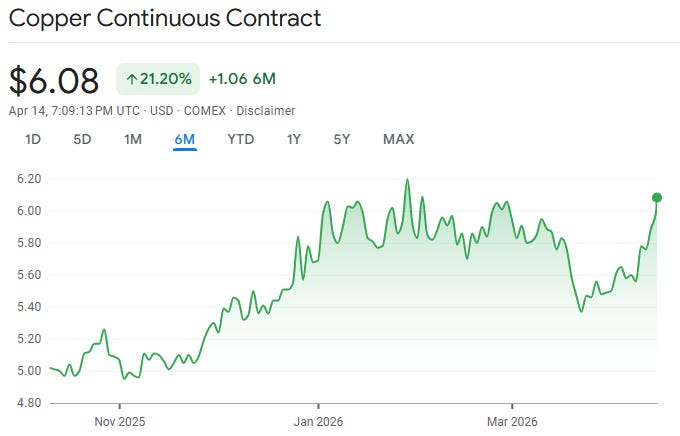
However, a new and arguably dangerous narrative has taken hold among retail investors and institutional allocators alike. Recognising the copper deficit, market participants are indiscriminately buying mining companies, working under the assumption that any exposure to the resources sector provides a safe harbour for capturing the copper upside.
This is an error and demonstrates a lack of macro sophistication.
Purchasing shares in diversified giants, specifically BHP Group, represents a complete misunderstanding of contemporary commodity dynamics. Buying BHP today is not an investment in the future of AI or the green energy transition. It is an investment in a decaying macro thesis from the previous decade.
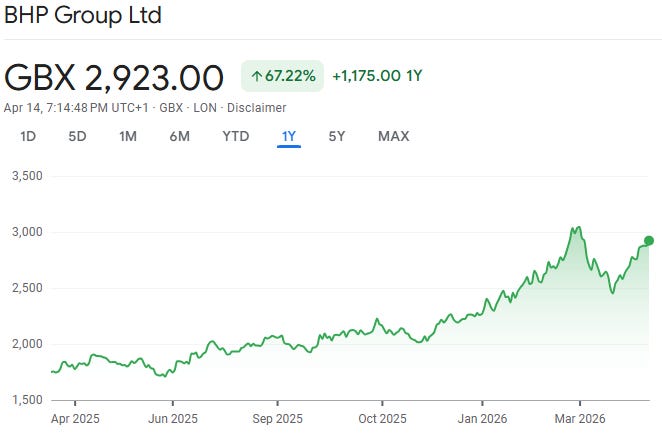
It requires the investor to catch the falling knife of the Chinese real estate sector, effectively subsidising legacy fossil fuel and ferrous metal assets with the cash flows generated by modern electrification demands.
To properly capitalise on the deficit in conductive metals, investors require a vehicle that offers unhedged, concentrated exposure to the underlying thesis, insulated from the geopolitical decay of the traditional industrial economy.
That vehicle is Freeport-McMoRan ($FCX).
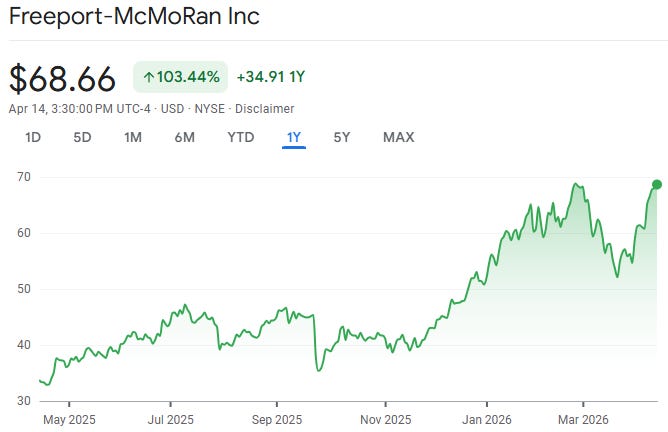
FCX provides pure-play copper leverage, dominant positioning within the sovereign security perimeter of the USA, and an unparalleled technological advantage in asset extraction.
This report will contrast BHP with FCX, proving why the latter is the only acceptable portfolio allocation for the current market regime.
The Illusion of Diversification and the Chinese Falling Knife
When initially reading about copper, and researching the best companies to provide me upside to the impending bull cycle, I actually thought BHP looked attractive.
Management had a strong track record of shareholder returns and smart capital allocation for decades time, their cost of production is incredibly low, and the company can maintain profitability and generate strong FCF even when commodity prices experience cyclical dips
However, I have since come to realise that BHP has become a hollow shell of a company, and it is only a matter of time until that shell cracks.
The primary bull case for BHP rests on the perceived safety of its diversified portfolio, and a quick glance at their most recent financial results appears to validate this optimism. For the first time in the company’s modern history, copper operations generated the largest share of overall earnings, delivering $7.95 billion in underlying EBITDA and accounting for 51% of total operational earnings.
This milestone was heavily promoted by management as proof of a successful portfolio transition toward future-facing commodities, boasting a sector-leading 55% overall EBITDA margin.
However, a more careful dissection of the earnings mix reveals a far more perilous reality for the prospective shareholder. Despite the rise in copper prices, BHP’s iron ore operations still generated $7.50 billion in underlying EBITDA, 48.5% of total operational earnings.
Furthermore, the company remains heavily exposed to steelmaking coal, an asset class facing existential terminal decline. During the previous decade, iron ore routinely constituted between 75% and 80% of BHP’s operational EBITDA. The relative decline to 48.5% is not only the result of copper growth, it is also because of a huge collapse in Chinese steel demand.
The global iron ore market is entirely reliant on China, specifically the Chinese property sector. Between 1990 and 2020, Chinese urbanisation drove the greatest commodity super-cycle in human history.
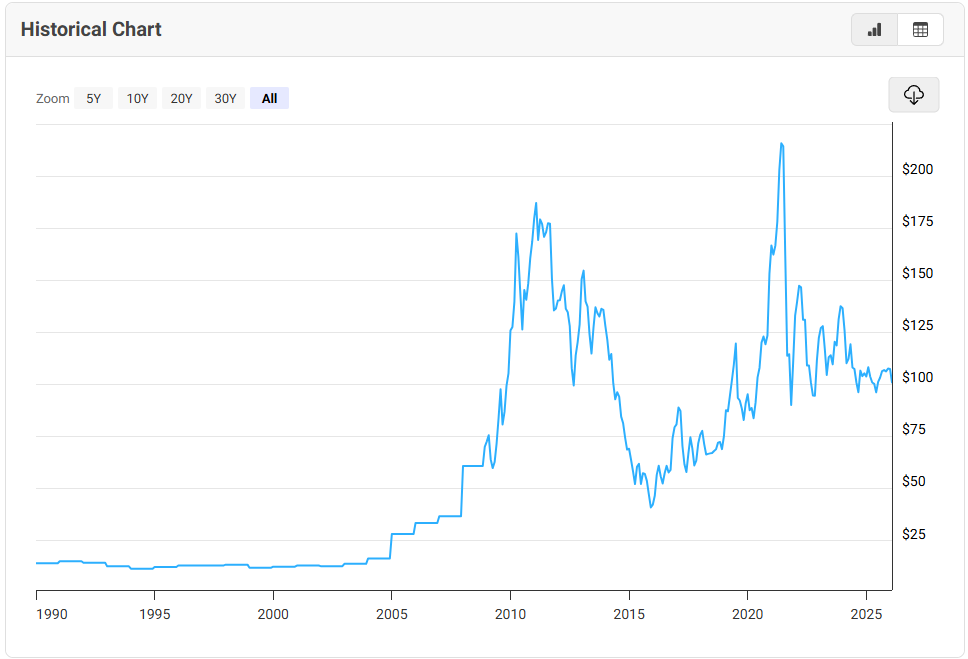
At the peak of this expansion, the Chinese property sector alone consumed 350 million tonnes of steel a year. Today, that consumption has cratered to 250 million tonnes. Chinese steel demand is expected to decline by a further 1.5% in 2026, confirming that the housing market decline is structural rather than cyclical.
Chinese economic maturation is definitively shifting toward services and technology sectors, massively reducing the steel intensity required for GDP growth. While Beijing has attempted to pivot investment toward infrastructure and advanced manufacturing, these sectors are fundamentally less steel-intensive. Consequently, Chinese manufacturing activity has remained stuck in contraction for consecutive months, and domestic steel margins have violently contracted.
When an investor buys BHP, they are inadvertently taking a massive long position on the recovery of the Chinese real estate market.
They are betting against the demographic realities of a shrinking Chinese population and a massive inventory of unsold apartments. Global steel production is expected to decline incrementally over the next decade from over a billion tonnes down to 900 million tonnes.
As Chinese demand shrinks, new iron ore supply is simultaneously flooding the market. The massive Simandou project in Guinea, backed by Chinese capital, is expected to ramp up to between 40 and 50 million tonnes annually by 2027. This impending oversupply will compress BHP’s iron ore margins, which currently sit at a highly vulnerable 62%.
Forecasts from major investment banks and trading platforms project average iron ore prices to decline steadily toward $95/tonne in 2026 (prices are currently just above $100/tonne) and potentially lower in 2027, creating a massive earnings drag on the overall BHP portfolio.
The Weaponisation of Commodities
Beyond the simple supply and demand mechanics (which already look terrible), BHP faces market access risks orchestrated by the Chinese state. Recognising their reliance on Australian iron ore, Beijing established the China Mineral Resources Group, or CMRG, to centralise purchasing power and break the pricing oligopoly held by the major miners.
This entity acts as a buyer’s monopoly, wielding sovereign authority to dictate terms and manipulate trade flows.
By late 2025, the CMRG began systematically banning specific BHP iron ore products as a negotiation tactic. While BHP has attempted to redirect shipments to secondary markets such as Malaysia and Vietnam, China remains the inescapable centre of gravity for global iron ore consumption.
This dynamic illustrates the asymmetry of risk inherent in holding BHP stock. A pure-play copper thesis relies on the globally distributed, exponential growth of data centres, AI, and electrical grid modernisation.
The iron ore thesis relies entirely on the political goodwill of a single, highly centralised government which is openly adversarial to the West and also actively attempting to suppress raw material costs.
Consequently, the strong cash flows currently generated by BHP’s tier-one copper assets in Chile and South Australia are continually diluted by the margin compression and geopolitical hostage-taking occurring within their ferrous metals division.
Strategic Paralysis and the Anglo American Failure
The vulnerabilities within BHP’s portfolio are not a secret to their leadership. The realisation that their legacy assets face terminal decline drove BHP’s desperate, multi-billion-dollar attempts to acquire Anglo American throughout 2024 and 2025. This pursuit was driven by an urgent need to secure generational copper rights before the AI demand shock rendered such assets entirely unaffordable.
BHP’s final approach on the 21st of November 2025 offered Anglo American shareholders an aggressive premium of up to 30% above the undisturbed market price, valuing the combined entity at an astronomical $170 billion.
Had the acquisition succeeded, BHP would have controlled 15% of global mined copper supply, definitively overtaking Chile’s Codelco as the undisputed titan of the metal.
However, the failure of this bid exposes a large weakness in BHP’s corporate architecture and dealmaking capability. The acquisition collapsed entirely because BHP insisted on a complex condition requiring Anglo American to demerge its South African holdings. This mandate introduced unacceptable execution risks and immediately alienated the South African government, notably the state-owned Public Investment Corporation, which held a significant stake in Anglo American.
Anglo Teck and BHP’s Isolation
Following the rejection of BHP’s overtures, Anglo American intelligently agreed to a merger of equals with Canada’s Teck Resources. Announced in September 2025 and overwhelmingly approved by shareholders on the 9th of December 2025, the $53 billion creation of the Anglo Teck group established a formidable new competitor.
Headquartered in Vancouver, over 70% of Anglo Teck’s earnings are derived directly from copper. This integration will add around 175,000 tonnes of potential annual copper production with minimal CapEx, drastically altering the competitive landscape.
BHP was forced to formally abandon its pursuit on the 24th of November 2025. Under UK regulations, this withdrawal precludes BHP from making another attempt for six months, effectively locking them out of the most significant copper consolidation of the decade.
This sequence of events leaves BHP isolated. While competitors aggressively consolidate the remaining tier-one copper reserves, BHP is forced to rely on organic growth projects that carry immense capital burdens and extended development timelines.
Buying BHP means buying a management team that identified the copper deficit correctly but failed entirely to execute the necessary corporate manoeuvres to capture it.
Freeport-McMoRan
In stark contrast to the bloated, paralysed BHP, FCX operates with lethal efficiency.
They are unburdened by dying coal assets, completely insulated from the Chinese property collapse, and uniquely positioned to capitalise on the most aggressive infrastructure buildout in modern economic history.
FCX stands directly upstream of the AI demand shock. Generating $8.9 billion in revenue with a sector-leading 58% EBITDA margin, the company provides exact exposure to the electrification thesis. They are actively shaping the domestic supply chains required to sustain American technological dominance.
Sovereign Security and the Domestic Premium
The fragmentation of the global economy has completely changed the value of essential commodities. Mining a mineral is no longer sufficient. The location of the extraction and processing infrastructure is now extremely important.
In November 2025, the US formally added copper to its 2025 list of critical minerals. This designation unlocked expedited federal permitting processes and substantial Department of Energy funding for domestic operators, explicitly categorising copper as vital to national security.
Simultaneously, the imposition of 50% tariffs on imported semi-finished copper products effectively severed the US from reliance on foreign processing hubs, particularly those in China.
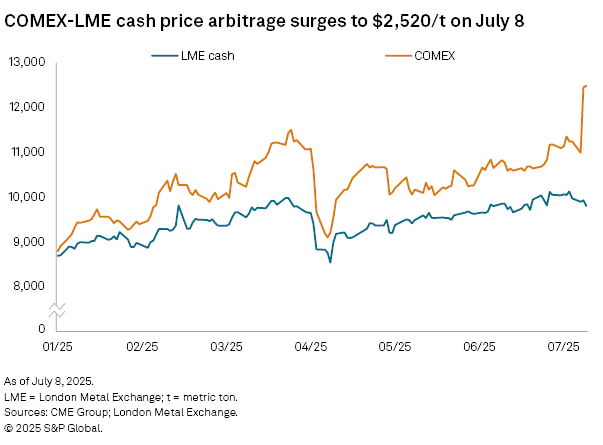
These protectionist policy changes have created a massive premium for domestically sourced and refined copper. Domestic buyers are now paying significantly more than the London Metal Exchange benchmark as they navigate these new trade barriers, leading to extreme profitability for onshore suppliers.
FCX controls 70% of the refined copper produced within the US. With an expansive domestic footprint that includes many mines in Arizona, alongside multiple operations in New Mexico, the company is entirely insulated from global shipping disruptions and international trade wars.
When hyperscale technology companies require thousands of miles of copper cabling to build domestic compute clusters, they are reliant on FCX’s output. This creates a market environment where FCX can dictate pricing terms far above the base spot rate, cementing their status as the USA’s copper champion.
Furthermore, the company has heavily invested in autonomous haulage systems, with entire mine fleets transitioning to being fully autonomous operations by the end of 2025, drastically lowering operational expenditures and insulating the company from domestic labour inflation.
Forging Pricing Power from Disruption
On the 8th of September 2025, FCX suffered a severe disruption at the Grasberg minerals district in Indonesia. A catastrophic mudflow released 800,000 metric tons of wet material from the former open-pit area into the underground workings, tragically resulting in seven fatalities.
Management immediately declared force majeure, suspended operations, and initiated an exhaustive investigation alongside Indonesian authorities. The incident rendered Q4 2025 sales from the region statistically insignificant and forced a downward revision in forward guidance.
Production for 2026 is currently projected at 1.0 billion pounds of copper and 0.9 million ounces of gold, a 35% reduction from pre-incident estimates.
Retail analysts viewed this as a catastrophic blow to the company’s valuation and indiscriminately sold the stock. Sophisticated investors understood the paradox of commodity constraints.
The Grasberg complex is the second-largest copper mine on earth. When an asset of this magnitude declares force majeure, the entire global supply chain experiences immediate shockwaves. The sudden removal of hundreds of thousands of tonnes of anticipated supply exacerbated an already giant structural deficit projected for 2026. Copper prices rallied massively as such.
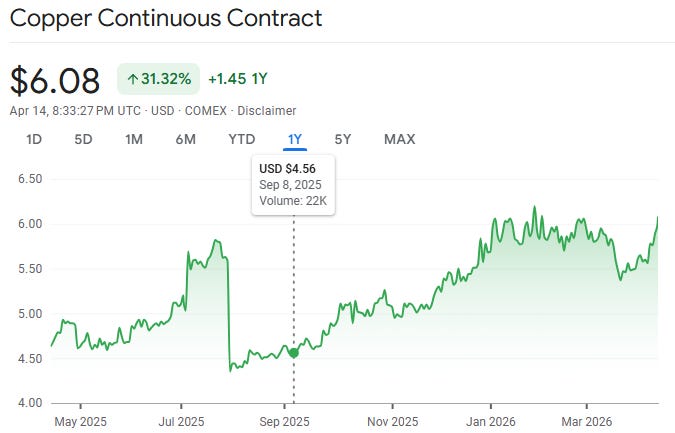
Because FCX is geographically diversified, the temporary volume loss in Indonesia was entirely offset by the extraordinary margin expansion experienced across their North and South American operations. The company effectively retained its earnings power through price appreciation directly caused by its own supply disruption, allowing them to report an adjusted EBITDA of nearly $10 billion for the fiscal year 2025, perfectly maintaining parity with 2024 levels.
Furthermore, the recovery protocol is proceeding well, with unaffected operations resuming in late October 2025. The core Grasberg cave is currently undergoing a meticulous restart throughout Q2 2026. Management projects that the complex will reach 85% of its operating capacity by the second half of 2026, with a complete return to pre-incident production levels of 1.6 billion pounds of copper annually by 2027.
Crucially, the company also recently secured a deal with the Indonesian government extending their special mining business license beyond 2041. This agreement involves transferring a 12% share interest to government entities at no cost while ensuring reimbursement for pro-rata costs, permanently resolving the long-term jurisdictional overhang that previously suppressed the stock’s valuation multiple.
The Americas Leach Innovation Programme
The ultimate differentiator distinguishing FCX from competitors like BHP is their approach to production expansion. Developing a new greenfield copper mine in the modern regulatory environment requires 10-15 years of capital-intensive permitting, environmental impact studies, and infrastructure construction.
FCX has bypassed this decade-long delay through a revolutionary application of chemical engineering and AI.
The company’s ‘Leach to the Last Drop’ initiative is systematically extracting copper from historical waste rock stockpiles that were previously considered entirely uneconomic due to technological limitations at the time of initial mining. Across their North and South American operations, an estimated 39 billion pounds of residual copper is currently trapped in these legacy mounds.
By deploying advanced sensor networks to monitor oxygen and temperature, using AI analytics to optimise chemical reactions, and installing vast plastic covers to retain thermal energy and reduce evaporation, the company is effectively mining without moving any earth.
The economics of this operation are staggering. Because the rock has already been blasted, hauled, and crushed by previous generations of miners, the capital intensity of the leaching process is virtually nonexistent. The environmental footprint is pristine, requiring no new water allocation and completely eliminating the carbon emissions associated with heavy machinery operation.
This process produced over 200 million pounds of ultra-low-cost copper in 2025.
Management is targeting 300 million pounds for 2026. By 2030, this process is projected to yield 800 million pounds of recovered copper annually. This volume is equivalent to discovering, permitting, and operating a brand new, world-class tier-one mine directly within the borders of the USA, producing metal at costs well below $1.00/pound.
The US Department of Energy has recognised the brilliance of this approach, recently awarding Freeport-McMoRan an $80 million grant through a cooperative agreement to integrate industrial-scale geothermal energy to heat leaching stockpiles. This project will also integrate battery energy storage and microgrid operations to improve electrical reliability.
The total cost of the project, including the geothermal and power grid elements, is $175 million, including the Department of Energy contribution. This partnership will generate clean, industrial-scale heat to further enhance chemical recovery rates, making the leaching programme the most capital-efficient production growth pipeline in the entire natural resources sector.
While competitors waste billions attempting hostile takeovers to secure marginal reserves, FCX is manufacturing supply out of thin air using software and geothermal heat.
Pure-Play Domestic Allocation
The implications of holding a pure-play US operator versus an iron-heavy Australian conglomerate extend far beyond immediate cash flow generation.
Every dollar generated by Freeport-McMoRan is either returned directly to shareholders or reinvested into high-return domestic copper expansions. Conversely, capital generated by BHP’s copper assets is routinely siphoned off to sustain dividend payouts while their iron ore margins collapse, or diverted into massive investment plans with uncertain ROI. BHP is incapable of compounding copper wealth because its corporate architecture demands the subsidisation of legacy divisions.
There is also the geopolitical premium. US tech companies require secure supply chains to maintain global dominance in AI. The United States Department of War requires secure supply chains to maintain military supremacy. FCX commands a premium because they control the infrastructure required to build domestic compute clusters. They are entirely immune to Chinese trade retaliation, whereas BHP faces existential risks every time the CMRG decides to alter its procurement strategy or ban a specific grade of Australian ore.
As Freeport-McMoRan supplies the critical infrastructure for the domestic electrical grid and data centre buildout, they effectively transition from a cyclical mining company into a tech-infrastructure proxy. Their valuation multiple must expand to reflect this reality, disconnecting entirely from the cyclical manufacturing indices that govern traditional mining conglomerates.
